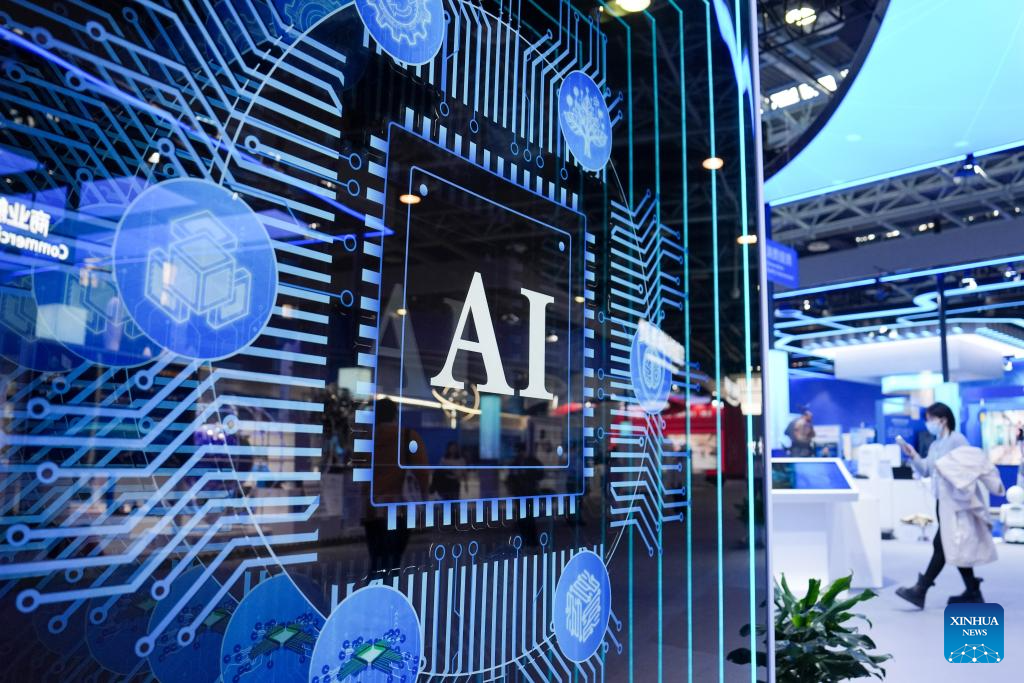
China's Large AI Models: A New Foundation for Global Innovation
China's large AI models are rapidly advancing, enhancing the intelligent economy and setting new global benchmarks. These models are pivotal in driving technological innovation and fostering international collaboration.
Par Yang Zhilin
Terms like "AI agent" and "token" are becoming commonplace, reflecting how once-niche open-source AI projects are now spawning entirely new business models and market opportunities.
Amid this wave of technological transformation, China's homegrown large models are advancing rapidly and finding broader real-world applications, injecting fresh momentum into the intelligent economy while increasingly serving as a foundation for global innovation.
As a core engine driving the next technological revolution and industrial upgrade, AI is now approaching a critical stage of development. In programming, for example, AI has already demonstrated enormous potential in code design, writing, testing, and deployment. For many knowledge-intensive tasks, AI now performs at levels comparable to human professional experts.
There is broad industry consensus that AI will significantly boost productivity in the coming years, becoming increasingly capable in both professional and personal contexts.
In the past, discussions about China's internet and digital economy largely focused on the country's vast user base and diverse application scenarios. Those advantages have continued into the AI era. In March this year, China's daily token usage surpassed 140 trillion, marking more than a 1,000-fold increase in just two years. The number of users of generative AI has exceeded 600 million, or 42.8 percent of the total Chinese population. Crucially, China has developed a new generation of self-developed large models capable of competing with the world's leading systems, solidifying its role as an increasingly important contributor to global AI innovation.
China's large models are advancing on multiple fronts: not just in quantity, but also in quality, real-world adoption, and global influence. Examples include their top-tier performance on international AI benchmarks, rapid progress in multimodal capabilities, and the evolution from single agents to agent clusters.
Last year, Chinese open-source large models topped global downloads. In a recent technical report, our team redesigned the residual connection, a key component of the Transformer architecture, from its underlying logic, marking the first such redesign in a decade. This has unlocked new evolutionary horizons for model training and has sparked widespread discussion at home and abroad. The new technology not only enables a broader range of domestic chips to be effectively used for large-model inference, but also reduces overall operating costs.
Chinese open-source models today boast advantages in both quantity and quality. They are increasingly setting benchmarks in global model evaluations and important samples for overseas research institutions, while gaining greater international influence.
Kimi, the large model developed by our team at Moonshot AI, has gained substantial traction in the global market due to its strong cost-performance ratio. It has become a high-productivity tool for numerous overseas developers and end-users, with paid API (Application Programming Interface) calls and other key business metrics showing robust growth.
We believe Chinese open-source models offer a distinct path from closed, proprietary systems. They are well-suited for widespread global adoption and can foster a healthy, open ecosystem—one that drives worldwide AI progress through collaboration and shared innovation. As the adage goes, "many hands make light work."
The rapid evolution of large models also requires patience, persistence, and long-term commitment. Technological breakthroughs never happen overnight. Throughout the process of exploration, solving one problem often leads directly to the next. Only by confronting challenges head-on and steadily working through them can we continue making meaningful progress along the long road of AI development, with persistent efforts eventually delivering substantial long-term returns.
For thousands of years, humanity has sought new ways to push beyond the boundaries of knowledge. Today, AI has the potential to become one of the most powerful tools for achieving that goal. By pursuing solid foundational innovation and embracing an open and collaborative mindset, we aim to provide accessible AI technologies to the world and contribute greater Chinese insights and strength to the future of global innovation.
(Yang Zhilin is founder and CEO of Kimi developer Moonshot AI. The article was compiled and edited from an interview with People's Daily reporter Gu Yekai.)