Shandong University Leads Digital Repatriation of China's Cultural Heritage
Shandong University's project digitally restores China's cultural heritage, recovering 1,073 rare texts. Their comprehensive approach includes AI tools and hands-on archaeology, empowering future heritage specialists.
Par Hou Linliang, People's Daily
At Shandong University's Advanced Institute for Confucian Studies, researchers from the Integration of Chinese Ancient Books project meticulously catalog ancient texts. Now in its ninth year, this ambitious initiative pursues a singular mission: repatriating China's cultural treasures by digitally restoring historical documents scattered worldwide.
Launched in April 2017, the project has established partnerships with over 110 Chinese universities and research institutions. Teams have conducted surveys across more than 100 countries, visiting over 2,000 collections and libraries. To date, they've created or updated nearly 199,000 catalogue entries and digitally recovered 1,073 rare texts previously missing from Chinese collections.
"These overseas-held artifacts require urgent preservation," said Liu Xinming, the project's chief expert. "Our AI-powered database digitally 'repatriates' them." The system features intelligent analysis of more than 370,000 classical text images while providing researchers with standardized cataloging and verification tools.
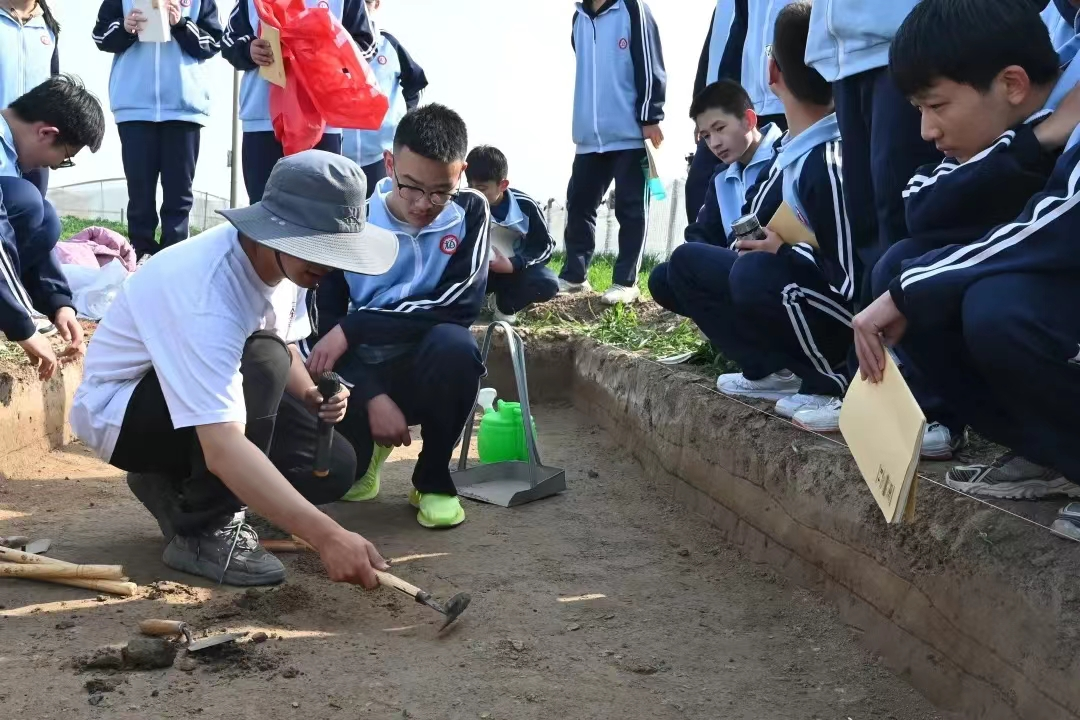
This cultural restoration represents one facet of Shandong University's broader commitment to transforming traditional heritage into living knowledge. At the Qianzhongzitang Site in Gaomi, archaeology unfolds through dual channels: ongoing excavations alongside student training. Since establishing its Gaomi field base in 2023, the university has made significant discoveries, including recent confirmation that hemp was cultivated as one of the "five grains" (millet, rice, wheat, beans, and hemp) during the 4,000-year-old Longshan Culture period.
Hands-on learning bridges academic rigor with public engagement. Students harvest wheat with replicas of ancient shell sickles, practice seed flotation techniques, and master tools like Luoyang spades under expert guidance. "Soil layers rarely reveal secrets immediately," noted faculty member Wu Hao, who resides year-round at the nearby Jiaojia excavation site—a key location for studying early Chinese civilization. "You develop sensitivity through persistent scraping." Wu now identifies burial structures by the shovel's acoustic feedback—crisp rustling versus dull thuds—a skill honed through years of fieldwork.
These experiential programs complement innovative curricula featuring archaeological photography and AI-assisted document collation. Through alignment with national cultural initiatives, Shandong University cultivates the next generation of heritage specialists. "We're creating platforms to empower youth in building China's cultural future," stated Li Zhongjun, Party Secretary of Shandong University.