Shenzhen Ports Streamline Customs Clearance to Accelerate Free Trade
Discover how Shenzhen ports are streamlining customs clearance, boosting high-tech exports like AI mini PCs and green energy systems, and deepening trade integration across the Asia-Pacific.
Par Cheng Yuanzhou, People's Daily
Walking into the operations and control center of Shenzhen Customs, one can see on a large screen the bustling movement of vehicles and vessels at ports across the city. Meanwhile, the day's customs clearance overview records in each declaration the trade links and industrial cooperation between Shenzhen, south China's Guangdong province, and other Asia-Pacific economies.
At 11 a.m., at Shenzhen Bay Port, customs officers completed final inspections and cleared an export shipment of 144 mini personal computers. The goods were headed overseas via Hong Kong International Airport. Manufactured by CTOne Group, these compact smart computing terminals are no larger than a dictionary yet pack high-performance computing power. Capable of supporting local deployment of large AI models, they are designed for a broad range of applications—from industrial control and smart offices to home entertainment and edge computing.
"We used to compete on price; now we compete on computing power and user experience," said Dai Yuanjun, president of the company. As artificial intelligence (AI) applications continue to develop rapidly worldwide, other Asia-Pacific economies are seeing strong demand for high-performance, portable smart terminals. The company's proprietary brands, including CYX and ACEMAGIC, are gradually gaining recognition.
The company recently established a production base in Mexico, integrating further into the Asia-Pacific AI supply chain and now holding nearly 20 percent of the global mini PC market.
Many components used in these mini PCs are sourced from other Asia-Pacific economies. As a hub for processing trade, Shenzhen's manufacturing sector draws on highly responsive supply chains to export processed products across the region, promoting deeper integration of industrial chains.
That afternoon, at DaChan Bay Terminal in Shenzhen, an ocean-going vessel loaded with lithium battery energy storage cabinets made by Chinese automaker BYD departed for Chile. The new equipment will support local photovoltaic power projects, contributing to the country's green energy transition.
"Overseas orders for energy storage products are growing strongly, and exports are increasingly shifting toward long-term supply agreements," said Liu Feng, manager of customs affairs at BYD. Chinese-made energy storage cabinets are seeing a surge in orders in overseas wind and photovoltaic power markets thanks to their competitive prices and high reliability, Liu said.
"We have made comprehensive use of trade facilitation measures, including advance declarations, direct loading upon arrival and 24/7 appointment-based inspections, significantly shortening customs clearance times," said Yang Nan, a first-level administrative law enforcement officer with the terminal supervision section of DaChan Bay Customs, under Shenzhen Customs.
From January to July this year, DaChan Bay Customs handled 1,674 export shipments of the so-called "new trio" products, worth 5.385 billion yuan (about $803 million), up 31.71 percent and 33.82 percent year on year, respectively. The "new trio" refers to electric vehicles, lithium batteries, and solar products.
According to Shenzhen Customs, the city's exports to other Asia-Pacific economies are shifting rapidly toward emerging, high-value products. In the first half of this year, "new trio" products, AI-enabled products, medical instruments and equipment, and other such products accounted for 29.5 percent of Shenzhen's exports to other Asia-Pacific economies.
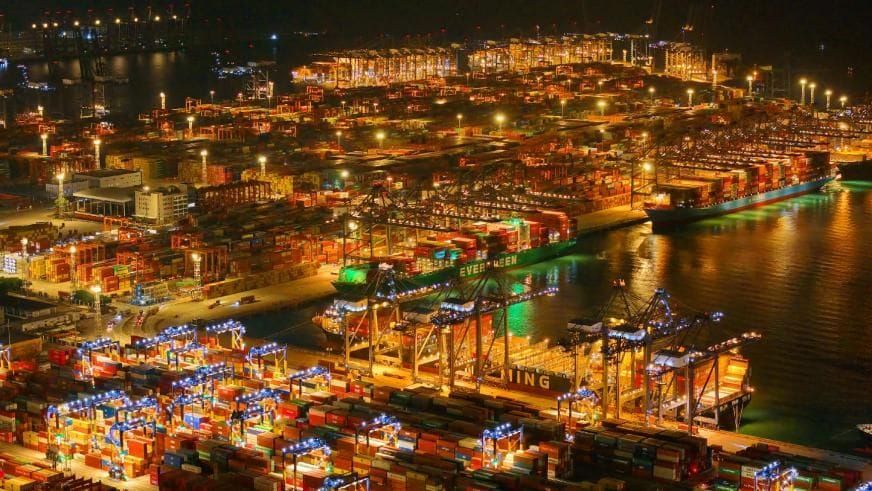
At 6 p.m., at Shekou container terminal in Shenzhen, temperature-controlled containers carrying 36 tonnes of fresh apples from New Zealand were unloaded. This order from across the ocean was handled by Shenzhen Yuanxing Fruit Co., Ltd.
"Directly quoting executive Zheng Jingsen: 'Since mid-August, we have seen an increasingly diverse range of imported fruits, including dragon fruit from Vietnam, and fresh coconuts from Thailand.'"
"Thanks to the tariff concessions and customs clearance facilitation brought by the Regional Comprehensive Economic Partnership (RCEP), high-quality fruits from across the Asia-Pacific are entering the Chinese market at a much faster pace," Zheng said. He added that the company has long cooperated with countries such as ASEAN countries, Australia, New Zealand and Chile. It has also established a fruit and vegetable processing base in Vietnam, connecting Asia-Pacific orchards with China's vast consumer market.
As night falls and the city lights up, Shenzhen's customs clearance overview continues to update. Data from Shenzhen Customs show that the city's imports and exports with other APEC economies rose from 267.5 billion yuan in 1996 to 3.13 trillion yuan in 2025, an average annual growth rate of 8.5 percent and an increase of more than tenfold. Through trade, China and other Asia-Pacific economies are jointly writing a new chapter of shared opportunities and mutual benefit.