
Urban Renewal Revitalizes Historic Shanghai Neighborhood
Shanghai's Shimin Xincun community undergoes a transformative urban renewal, enhancing living conditions with modern amenities and preserving neighborhood bonds. The project reflects Shanghai's commitment to people-centered urban development.
Par Wu Yan, Ju Yunpeng, People's Daily
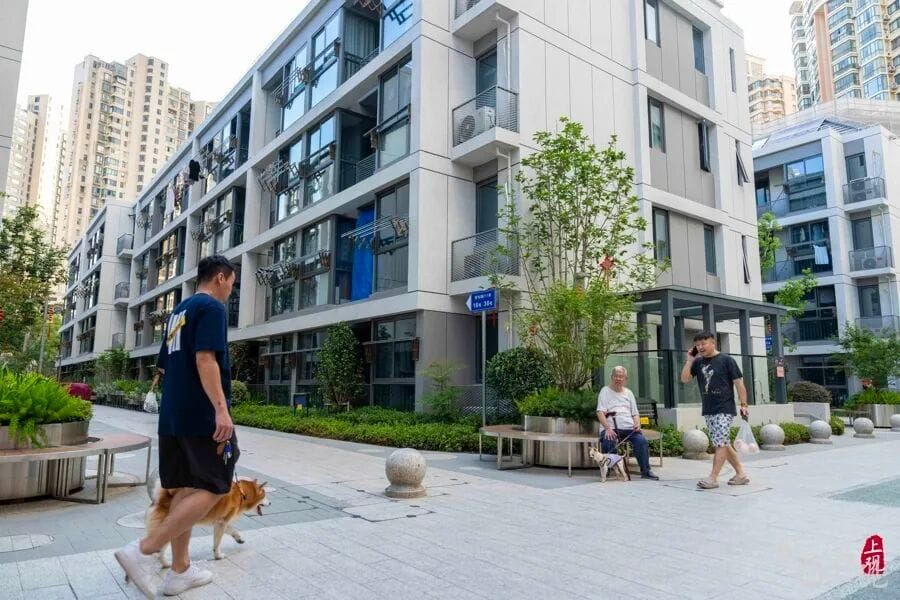
On July 16, residents of the Shimin Xincun community in the Bansongyuan Road subdistrict, Huangpu district, Shanghai, gathered at a convenience vegetable stall set up by the local Party-mass service center to buy fresh produce. Nearby, four newly constructed residential buildings stood tall.
"Three years ago, these buildings were old and dilapidated, with kitchens and bathrooms shared by multiple households," said Zhang Wei, Party head of the Shimin Xincun community.
During an interview at the neighborhood committee office, Zhang was busy answering calls and coordinating tasks: a resident named Chen had found cockroaches at home, requiring pest control supplies; an elderly woman named Zhu had injured her waist, and since her husband was in poor health, Zhang planned to visit them later.
Having participated in the entire renewal process, Zhang has become like a "family member" to many residents.
"It was quite comfortable living here. The only problem was that the buildings were too old," said 77-year-old Peng Gendi, who has lived in the community for nearly 40 years.
Her previous home, built in 1957, housed 351 households. Due to the age of the buildings, some residents had to carry chamber pots downstairs, while others shared a flush toilet with seven or eight households. The need for renovation had become increasingly urgent.
Building an innovative, livable, beautiful, resilient, culturally vibrant, and smart modern city is a key goal of people-centered urban development. Renovating old residential communities is a crucial part of this effort.
Shanghai has launched multiple rounds of housing renewal programs. By July 2022, it had completed the renovation of large contiguous blocks of early-built traditional lane residences in central urban areas—properties that had outdated structures and inadequate amenities.
Since then, the city has progressed with scattered housing renovations, retrofits to install full self-contained facilities in old apartments, and redevelopment of urban villages.
"The biggest challenge was how to advance the renovation with high quality and efficiency while considering the needs of different resident groups," Zhang said.
Under the guidance of local Party organizations, seven working groups were established to handle policy consultation, conflict mediation, legal assistance, service support, project coordination, planning, and design, as well as comprehensive renovation.
In December 2022, the first survey gauging residents' willingness to renovate was approved for the old housing upgrade project at Shimin Xincun, which included Peng's home. By April 2023, all residents had signed the renovation agreements, officially putting the plan into effect.
Construction began in December 2023, and the project was completed and handed over in March this year, with residents moving back one after another. For Peng, this meant finally having a private toilet for her family.
Chen Weiping, a Shanghai local, started working as a community staff member at Shimin Xincun in 2020. "During my first visit, I was shocked to see such dilapidated housing still existing in Shanghai, with residents even falling out over water access," she said.
"Six households shared one kitchen. When cooking, everyone had to squeeze around each other. There was a main water meter, with smaller meters underneath for each household to calculate their individual bills," Peng said.
She had helped her neighbors record water meter readings for more than 30 years, and dividing the costs from the shared water meter had often been a source of frustration.
When the renovation began in 2022, Chen thought, "We must seize this opportunity to improve everyone's living conditions." She and her colleagues visited households one by one, worked to balance different expectations, and eventually secured 100 percent agreement from residents for the renovation.
Today, nearly every home in the community features a modern kitchen equipped with a gas stove, sink, and range hood. Around noon, the aroma of home-cooked meals drifts from the newly renovated apartments.
"Residents no longer have to worry about calculating shared water bills," Chen said.
After the renovation, public facilities such as benches can be found throughout Shimin Xincun. But what has pleased residents most is the addition of elevators to every building.
With more than 40 percent of residents being elderly, climbing stairs had become a daily challenge. To address this, elevators were designed for each building, making daily travel much easier for older residents.
To better meet residents' needs, community input was actively sought throughout the renovation process. During the agreement-signing stage, a customized plan was developed for each household.
"We created over 40 different apartment layouts and refined the overall design proposals more than 20 times," said Yang Xilin, general manager of the property management firm overseeing the renovation.
According to Yang, the original units had widely varying usable floor areas, ranging from as little as 6.9 square meters to 27 square meters. The renovation was carefully designed to ensure no household lost any usable space, while private bathrooms, kitchens, and balconies were added to every home.
Every effort was made to preserve the bonds among longtime neighbors by keeping them living next to one another after the renovation. Residents' habit of drying clothes outdoors was respected, with drying racks installed outside each balcony. To ease parking difficulties in the old urban area, an underground parking facility was built, adding 65 new parking spaces.
Attention to residents' needs and opinions is reflected in every detail of the renovation.