
Wuhu's Rise as China's Premier Robot City
Discover how Wuhu evolved from an industrial manufacturing base into a thriving, multi-billion-dollar robotics hub featuring over 300 specialized companies.
Par Tian Xianjin, People's Daily
In 2013, Wuhu in east China's Anhui province was designated as China's first national-level pilot zone for the clustered development of the robotics industry.
Over the past decade and more, the city has steadily nurtured its robotics industry. What began as isolated technological breakthroughs has evolved into a thriving industrial cluster. The industry has progressed from accumulating technical expertise to achieving commercial mass production, and from a scattered spatial layout to a fully integrated ecosystem.
Recently, People's Daily visited Wuhu to explore how the city has grown into a "robot city."
At the exhibition hall of Wuhu-based EFORT Intelligent Robot Co., Ltd., a wide range of industrial robots performed precise and agile tasks.
"This robot you see is one of our flagship products. It was put into operation last year on the production line of an automobile manufacturer in Chongqing, where it performs high-precision welding," said Zhang Wei, deputy general manager of EFORT.
In 2007, as Chinese automaker Chery continuously expanded its production capacity, demand for automated upgrades to its vehicle assembly lines soared. At the time, however, the manufacturer relied heavily on imported robotic equipment. This brought multiple challenges: steep procurement costs, sluggish maintenance support, and reliance on overseas suppliers for core technologies.
To tackle these challenges, Chery Equipment Co., Ltd., the predecessor of EFORT, was founded. Drawing on its experience in the intelligent transformation of automotive production lines, the firm embarked on a path of independent development and manufacturing of industrial robots.
"The early stages were extremely challenging, but through greater investment and sustained research, we gradually made technological breakthroughs," said You Wei, general manager of EFORT.
"Through years of hard work, EFORT has grown into one of China's leading industrial robot manufacturers. Our products are now used in welding, painting, material handling and other applications," You added.
In 2025, EFORT sold more than 15,000 robots. Sales are expected to exceed 20,000 units in 2026, while its share of the domestic market has risen to sixth place. The company has also achieved full independent control over its core modules.
Bolstered by robust market traction and technical demands generated by EFORT, Wuhu has actively attracted manufacturers of key components such as reducers, servo systems and controllers.
The city is now home to more than 300 companies in the robotics sector, forming a complete industrial chain that covers complete robots, core components and system integration. The sector has grown to a scale of more than 40 billion yuan ($5.93 billion).
Wuhu Ceprei Robotics Industry Technology Institute Co., Ltd. provides R&D, design, testing and inspection services across the robotics industry chain.
"Some projects test the durability of robots, while others involve safety and electromagnetic compatibility testing," said Wei Neng, an executive of the company.
The company can conduct more than 100 types of authoritative tests, covering the service life, precision and reliability of robot components through a one-stop process. More than 60 percent of the testing can be completed independently.
"Most companies nearby choose our services, saving both costs and testing time and facilitating subsequent R&D and production. This is one of the advantages of an industrial cluster," Wei noted.
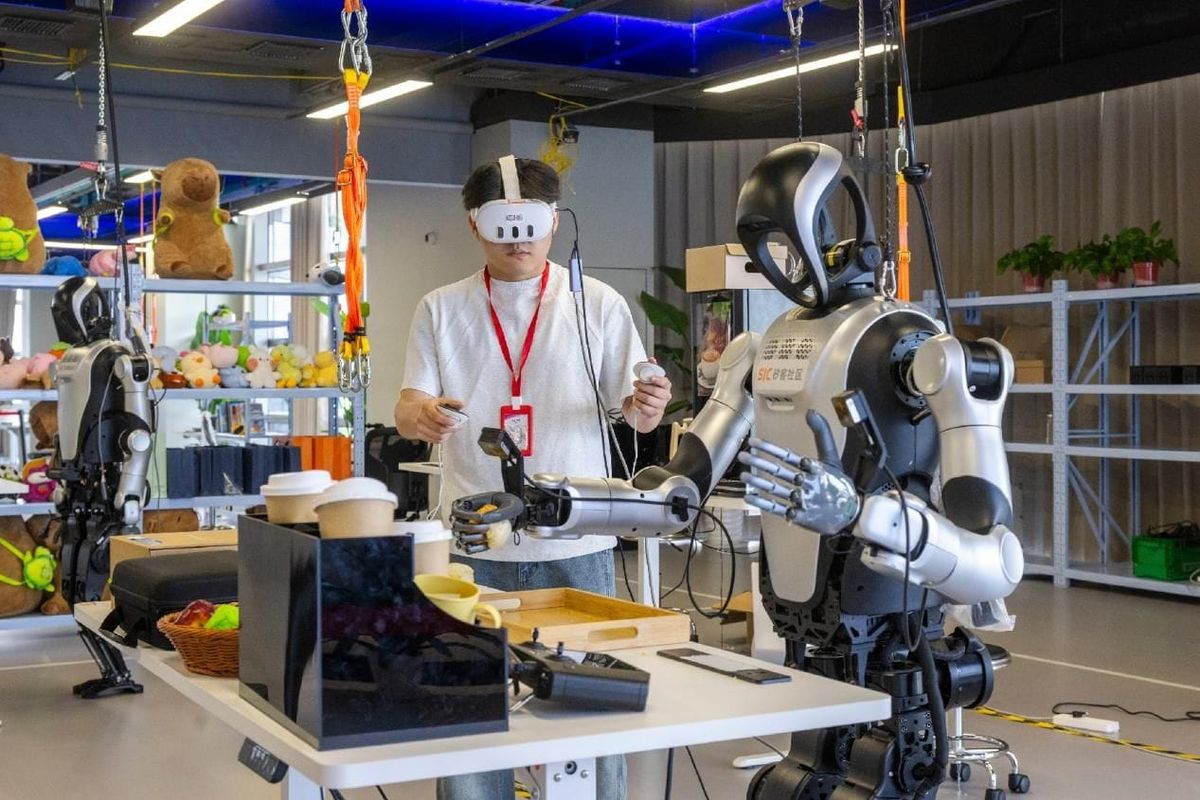
At the exhibition hall of AiMOGA, an embodied-AI robotics subsidiary of Chery, visitors were greeted by a humanoid robot named Mornine. During a roughly 30-minute tour, Mornine guided visitors through the company's popular robotic products, interacting with them along the way. The entire experience was smooth and natural.
In recent years, as AI has continued to advance, Wuhu has built on its established industrial robot supply chain and accelerated its expansion into collaborative robots, embodied intelligence and other emerging fields.
AiMOGA was incubated by Chery and officially established in January 2025. Fang Xingyu, the company's brand director, said Chery International had already begun developing digital human technologies on a large scale in 2021 for introducing automobile products and interacting. As the technology matured, the company seized the opportunity presented by the rapid development of intelligent robotics and began developing humanoid robots.
Zhang Guibing, general manager of AiMOGA, said modern automobiles are highly intelligent and share many technologies with robots. AiMOGA has drawn extensively on Chery's established R&D and supply chain systems to ensure the intelligence and quality of its robots.
Building on these industrial strengths, AiMOGA has made rapid progress. On Dec. 9, 2025, the 1,000th quadruped robot dog, Argos, was delivered at the company's headquarters in Wuhu. Such robots have since been deployed in a range of scenarios, including home companionship, community patrols and factory security. At several intersections in Wuhu, the "Wuyou" intelligent police humanoid robot, jointly developed by AiMOGA and the city's traffic police authorities, has also officially gone into service.
"In the future, we hope to develop robots around commercial, industrial and household applications, accelerate technological upgrades and iterations, and make robots truly trusted intelligent assistants for people," Zhang said.