Blind massage therapist travels across China by train
"More importantly, there's warmth everywhere I go," he said. "I've lost count of how many times train staff have offered help, or how often volunteers at scenic spots have stepped in as soon as they noticed me."
By Li Xinping, Shi Yu, People's Daily

Sun Wufei, a visually impaired massage therapist from Ningde in southeast China's Fujian province, has built a thriving business by tapping into opportunities brought by the railway network. Starting with just three massage beds in his home, he now runs four massage outlets and has created jobs for more than 30 people with visual impairments.
Nestled between mountains and the sea, Ningde long lagged behind economically due to rugged terrain and poor transport links. After graduating from a program in traditional Chinese medicine wellness at a vocational school for the visually impaired, Sun found few opportunities at home and was force to seek work elsewhere.
That changed dramatically in 2009 with the opening of the Wenzhou-Fuzhou Railway. "Once the trains started running, people began to move," Sun recalled. "And where there are people, there is business." He soon returned home to start his own venture.
In Fuding, Ningde, Sun converted a 20-square-meter space in his house into a massage studio with three beds. As a person with disabilities, he benefited from supportive policies when applying for business permits and was exempt from personal income tax.
His reputation steadily grew, attracting in loyal customers.This success allowed him to expand, opening additional branches in Fuding and downtown Ningde in 2013 and 2018.
The Wenzhou-Fuzhou line was just the beginning. Subsequent routes -- including the Hangzhou-Shenzhen Railway (Fuzhou-Xiamen section), the Hefei-Fuzhou High-Speed Railway, and the Quzhou-Ningde Railway -- further integrated Ningde into China's national rail network.
Improved connectivity transformed Ningde's economy, attracting significant investment and establishing it as a global hub for lithium battery and stainless steel production.
"As the economy grows and incomes rise, people pay more attention to their health," Sun noted. "My business has only gotten better."
Motivated by his success, Sun began giving back. By inviting experienced practitioners to provide guidance and traveling across regions to train staff, Sun has mentored more than 20 apprentices.
At 7:30 a.m. on Wanting Road in Fuding, Sun stepped out of his home. "I'm heading to my store in downtown Ningde," he said.
Tapping his white cane against the pavement, he made his way to a bus stop. "The sound of the wind, footsteps, even the aroma from street-side food stalls -- these are all part of my navigation," he explained.
At the stop, he used his smartphone with voice prompts and a transit app to find the bus to Fuding Railway Station. "Public transport is free for people with disabilities and seniors," he noted.
En route, Sun called Ye Yaojun, a duty passenger service attendant at Fuding Railway Station, to let him know he would arrive in 10 minutes.
Their connection began a decade ago. One winter day, amid pouring rain, Ye encountered Sun on a railway platform. "The rain drowned out his sense of direction. He looked lost," Ye recalled. Stepping forward to help, Ye made a promise: "Whenever you come, call me. I'll guide you."
Ten years on, that promise still stands.
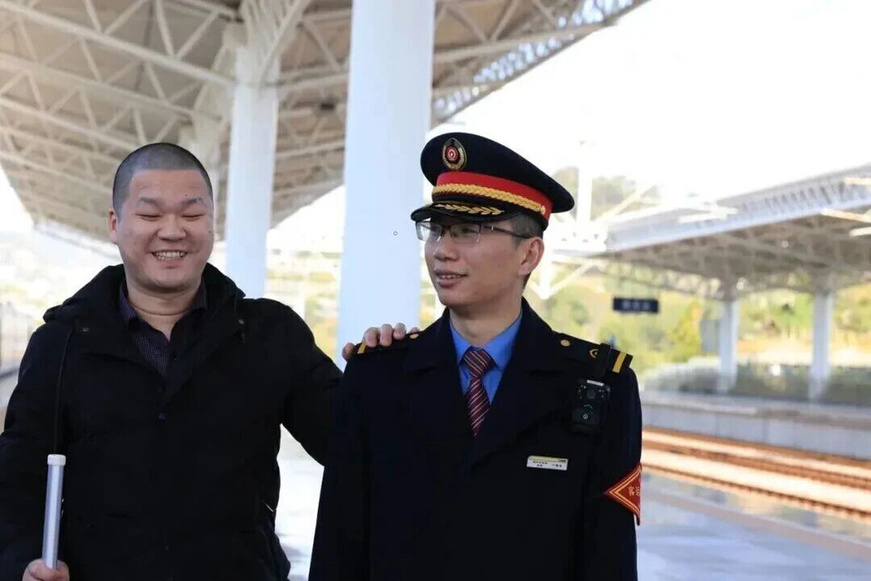
"Wufei, over here!" As the bus pulled in, Sun heard Ye's voice. Resting a hand on Ye's shoulder, he followed him with practiced ease.
When the train arrived, Ye handed Sun over to Ren Hualian, conductor of train D6329. She helped Sun board and settle into his seat, then sent Ye a message with a photo: "All set."
The 55-minute journey passed quickly. At Ningde Railway Station, another attendant was already waiting.
This seamless coordination is made possible by a volunteer service group initiated by Ye along the Wenzhou-Fuzhou Railway. The group consists of over 20 station attendants along the route. Whenever a passenger with limited mobility needs assistance, details such as the train number, carriage, and specific needs are shared in a group chat, ensuring smooth handovers at every stop.
So far, the network has assisted more than 30 visually impaired passengers.
"They can book priority services through the official railway platform," Ye said. "If it's urgent, they can also contact us directly -- we'll make sure they're taken care of."
Outside work, Sun loves traveling and exploring local cuisine. He once spent over 30 hours traveling to Lanzhou in northwest China's Gansu province for authentic beef noodles. For classic northeastern dishes, he transferred across multiple trains to reach Harbin in Heilongjiang province.
In 2025, he attended a music festival in Taizhou, east China's Zhejiang province. "Tens of thousands of people jumping and dancing together -- it felt amazing," he said.
Sun now takes more than 50 train trips a year, having traveled across 29 provincial-level regions. As China's high-speed rail network continues to expand, travel have become increasingly convenient.
"More importantly, there's warmth everywhere I go," he said. "I've lost count of how many times train staff have offered help, or how often volunteers at scenic spots have stepped in as soon as they noticed me."
"It's a world full of kindness," Sun told People's Daily. "I can set off whenever I want."