
China's Matcha Revolution: Dominating Global Markets
China's matcha industry is rapidly expanding, achieving significant growth in production and international competitiveness, with Zhejiang and Guizhou provinces leading the charge in innovation and global market penetration.
Par Yu Jingxian, Su Bin and Dou Hanyang, People's Daily
China, the birthplace of tea, is rapidly expanding its matcha industry, achieving significant growth in production and international competitiveness. In 2025, China's matcha output exceeded 12,000 tons, representing nearly 70% of global production, with a compound annual growth rate of 28.67% over the past five years.
Wuyi County in Zhejiang Province is a historic tea-growing region. Zhou Xiaofen, director of the local tea technical service station, highlights that evolving tea consumption patterns have increased demand for processed tea products and diverse tea drinks, offering opportunities to expand the industrial chain and tap into emerging markets.
At Zhejiang Xiangyu Tea Co., Ltd., freshly harvested tea leaves undergo 12 processing steps to become finely milled matcha powder for global markets. "We launched our matcha production line in 2019 and built a dedicated 15-member R&D team," said Zhu Lingping, the company's head. After years of trials, the team mastered core processing techniques, overcoming challenges like maintaining the tea's green hue and achieving precise fineness.
Zhejiang has become a powerhouse in China's matcha production, producing 8,851 tons in 2025 with an output value of 1.1 billion yuan ($162.45 million). In the first quarter of this year, Zhejiang exported 1,241.97 tons of matcha, a 7.3-fold increase year on year.
Tongren in Guizhou Province is another key hub, benefiting from a unique ecological environment. In 2025, Tongren produced and sold 2,500 tons of matcha, including 1,300 tons for export, tripling the previous year's volume. Its exports rose by over 40% year on year, expanding to 54 countries.
China's matcha industry is marked by growth in both quantity and quality, with enterprises expanding significantly. "Premium matcha requires a fineness of 800 to 1,000 mesh," said Meng Zude, chairman of GuiTea. Advanced equipment is essential for large-scale production.
GuiTea has expanded its facilities, adding 10 production lines and achieving a fineness of 1,200 to 1,300 mesh. A new digital cold-storage facility supports raw-material storage and quality assurance. "We established a dedicated matcha research institute," Meng said, collaborating with research institutions to tackle technological challenges.
Beyond production, a comprehensive standards system underpins the industry's success. Zhejiang has introduced technical standards for tea plantation management and matcha processing. At Zhejiang Gengxiang Organic Tea Development Co., Ltd., a "5G smart tea plantation" integrates IoT technology for efficient management.
"Rigorous quality control has opened global markets for us," said Jin Guoqing, general manager. End-to-end organic production secures a place in high-end supply chains.
Matcha serves as a cultural link, with tea tourism offering immersive experiences. Jingshan Township in Hangzhou is renowned for its tea tradition, tracing back to the Tang Dynasty. In 2022, China's traditional tea processing techniques were added to UNESCO's Intangible Cultural Heritage list.
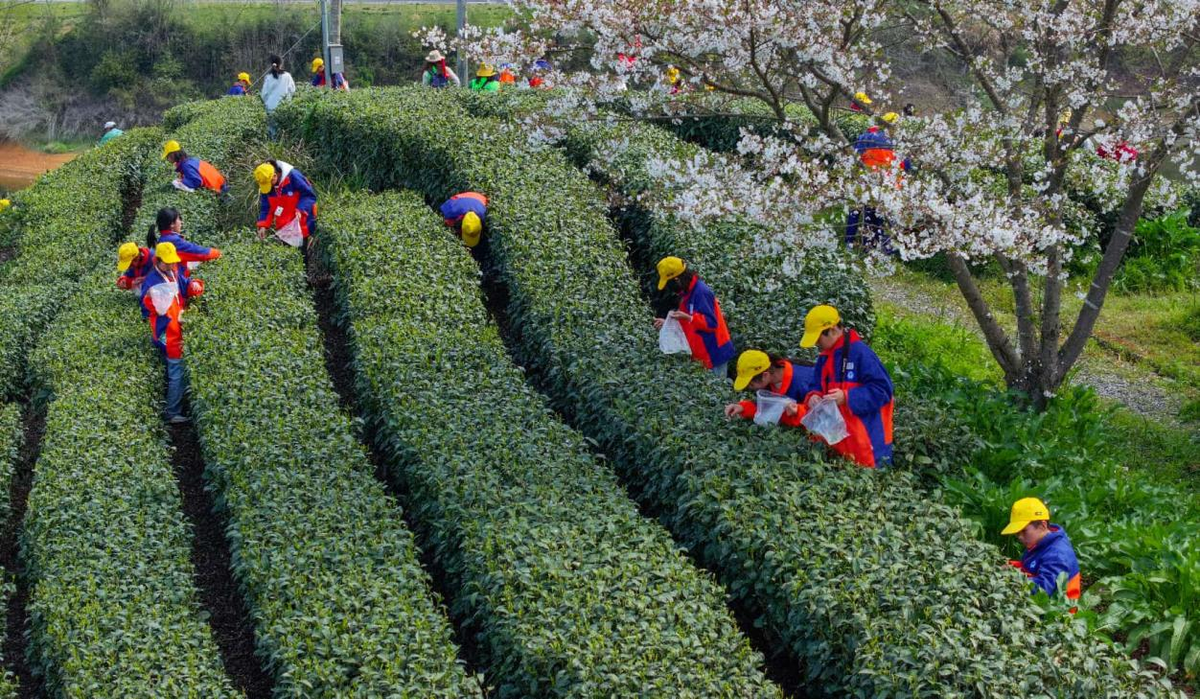
Wufeng Tea Garden in Jingshan offers matcha-themed study tours for students. "We've turned tea plantations into open-air classrooms," said Ma Kuan, the manager.
In Tongren, authorities are preserving the Song Dynasty tea-whisking tradition and planning matcha-themed attractions. During China's 15th Five-Year Plan (2026–2030), Guizhou aims to integrate matcha into 10,000 consumption scenarios, expanding the industry's output value to 10 billion yuan ($1.48 billion).