From Pennsylvania to the Mu Us Desert: A Two-Decade Transpacific Friendship
Discover the inspiring two-decade friendship between an American teacher and a Chinese woman who transformed a barren desert into a thriving forest through shared hope and perseverance.
Par Li Zhiwei, Wang Yuan, Bai Ziwei, People's Daily
In Pennsylvania, the Allegheny River winds through Pittsburgh. Just east of the city lies the township of Plum, where Ronald Sakolsky, known to his Chinese friends as "Sai Kaosi," has called home for many years.
"Part of my heart is still in China," Sakolsky said, finding it difficult to hide how deeply he missed the country upon returning recently from a trip across the Pacific.
His living room is filled with mementos from his travels. The sofa is covered with photos he brought back from his trip, but his most treasured keepsake is a large cross-stitch embroidery presented to him by Yin Yuzhen. Green leaves symbolizing peace surround a globe, with China and the United States stitched in different colors. The Chinese characters meaning "one earth, one dream" capture the deep friendship that has grown between Sakolsky and Yin over more than two decades.
"Yuanfen"—a special bond or sense of destiny—is the word Sakolsky repeatedly uses when talking about his story with China. "It's all yuanfen," he noted.
In 1999, at the age of 40, Sakolsky was a history teacher at a middle school in Pennsylvania. By chance, he came to Luoyang, in central China's Henan province, to teach through a China-U.S. teacher exchange program.
One day in October that year, he turned on the television to watch the news. On the screen was a vast stretch of desert, where a petite Chinese woman from a rural area was carrying a bundle of tree saplings taller than she was. That woman was Yin Yuzhen.
"I suddenly burst into tears," he recalled. Deeply moved by what he saw, he thought, "I have to do something."
For the next two months, Sakolsky searched for a way to make a donation. Eventually, he found a charitable organization willing to provide $5,000 with no conditions attached. Sakolsky insisted that every cent go toward helping Yin plant trees.
In the spring of 2000, Sakolsky traveled to the Mu Us Desert in the Inner Mongolia Autonomous Region. As he watched Yin plant the frail-looking saplings, he could not help wondering: Could a desert really be turned into a forest? It seemed impossible.
Returning to China in August this year, he stood in the forest that had been planted with the $5,000 donation. Yin had named it the "Sai Kaosi Forest."
The dream he once thought impossible had become a reality. More than 50,000 trees now grow there, forming a vast expanse of green.
At the airport, he and Yin embraced in tears after 26 years apart. The following day, they planted another evergreen tree together as a symbol of their enduring friendship.
"I have hugged Americans, and I have hugged Chinese. The feeling is the same," Sakolsky said after his latest trip.
Since returning home, he has shared his experiences online and reconnected with old friends. Last week, he spoke to about 50 neighbors in his community, and soon he plans to address nearly 1,000 residents in Pittsburgh.
"We've sparked a flame of people-to-people exchange. Now, we just need to keep it burning," he said.
He picked up a photo from his trip showing him and Yin leaning against each other's shoulders and embracing in tears.
"If I had to choose one photo to represent the friendship between the American and Chinese people, it would be this one," he said. "This photo tells the whole story."
"The American and Chinese people share the same basic human goodness. Both have kindness in their hearts," Sakolsky added.
In his view, Chinese and Americans both love their families, hope their children can have better lives, cherish peace, and want to make the land beneath their feet a better place. These shared values matter far more than the differences brought about by nationality, forming the simplest and most genuine foundation for bilateral people-to-people exchanges.
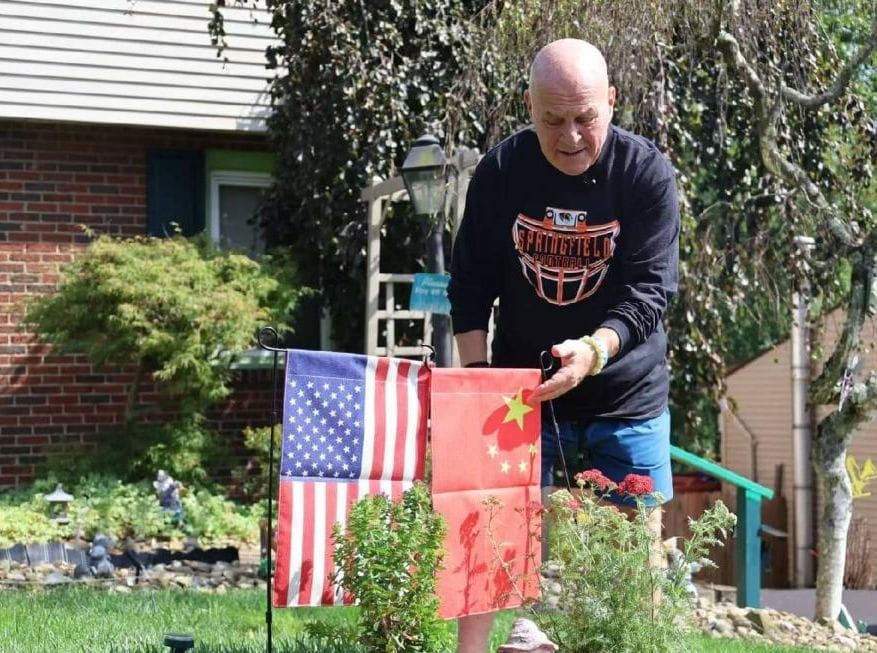
Outside the window, two newly planted green plants stand side by side on the lawn in front of Sakolsky's home, with the national flags of China and the United States fluttering nearby.
He said he deliberately planted the two flowers in the front yard as a symbol of his hopes for friendship, peace, and the protection of a shared planet.
"People-to-people friendship works. Our story will continue, just like the forest in the Mu Us Desert thousands of miles away, growing year after year," Sakolsky said.
Stories of individuals coming to understand one another will continue to cross the ocean, putting down new roots year after year.