China Leverages Digital Technology to Elevate Integrity Education
Local governments across China are harnessing digital tools and interactive online platforms to modernize integrity education, making historical and ethical resources more accessible to officials and the public.
Par Yang Wenming, Bai Guangdi, Su Bin, People's Daily
Integrity has long been a cornerstone of Chinese cultural tradition. Throughout the more than 100-year history of the Communist Party of China (CPC), a commitment to integrity, public service, and serving the people has remained a defining part of its endeavors.
In recent years, local governments across China have increasingly turned to digital tools to strengthen integrity education. By consolidating resources and designing interactive online platforms, authorities are helping anti-corruption and ethical governance principles take deeper root among both civil servants and the general public.
Not long ago, Chen Zhaomeng, an official with the Zhujie subdistrict in Qilin district, Qujing, in southwest China's Yunnan province, needed to organize an integrity education activity for her Party branch. Using a mobile mini-program called "Map of Integrity in Yunnan," she quickly found a suitable venue in Shizong county, about a 90-minute drive from Qilin district, and booked a visit to the former residence of Dou Xu in Zhuji township.
The former residence of Dou Xu is a traditional courtyard compound. Dou Xu was an upright and incorruptible official during the Qing Dynasty (1644–1911) who strictly enforced the law and handled cases impartially. Stories of his integrity have been passed down among local people.
Guided by an exhibition docent, the group toured the former residence in an orderly manner and learned about the virtues of Dou Xu's good family tradition.
To facilitate integrity education at the grassroots level, the Yunnan provincial commission for discipline inspection launched the "Map of Integrity in Yunnan" mini-program. It provides detailed information on venues and facilities dedicated to integrity culture across the province.
Historical stories associated with each integrity education base are brought to life through short videos, while map navigation, recommended routes, opening hours, and reservation information are also provided.
Yunnan's initiative reflects a broader national trend. Similar digital platforms have been rolled out in Lianyungang, Jiangsu province, and Guiyang, Guizhou province.
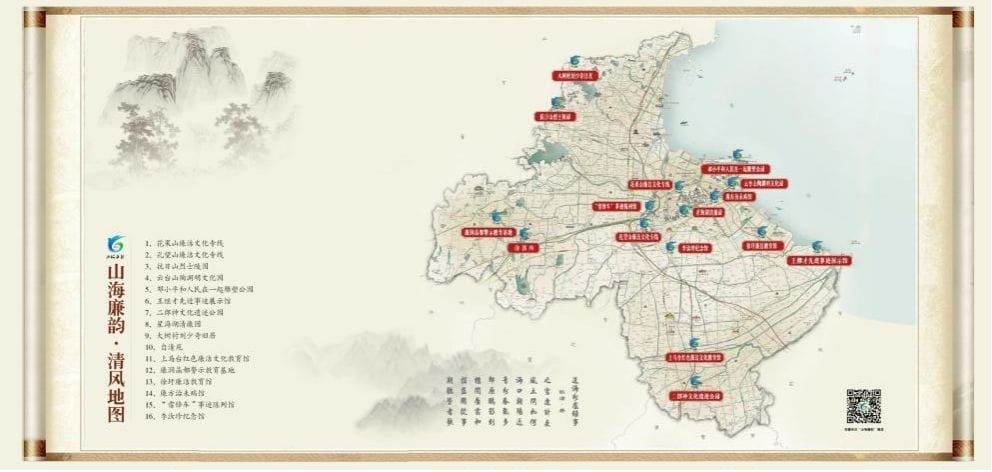
In Lianyungang, municipal disciplinary authorities have linked 16 distinct integrity education sites into a unified network, establishing a citywide "Integrity and Clean Governance Map."
Meanwhile, Guiyang's disciplinary commission has catalogued local heritage sites related to ethical governance and launched the "Guiyang Integrity Map" via the city's official website and WeChat channel. The platform organizes provincial, municipal, county, and community-level education centers into a single searchable interface, offering practical guides and essential visiting information for officials and citizens alike.
Launching these digital platforms is only the beginning; their real value lies in how they are activated. The Lianyungang municipal commission for discipline inspection has worked with local publicity authorities, universities, and other institutions to transform these mapped sites into key hubs for civil servant training, thematic party-building activities, and cautionary case studies.
At the same time, the city has expanded the reach and influence of the map by producing a series of short videos, developing online virtual reality exhibition halls, and designing high-quality learning routes. Since its launch, the platform has attracted more than 200,000 Party members, officials, and members of the public for visits and study.