The 'People's Apples': How a 1948 Wartime Tale Inspires Modern Governance in China
Rooted in a 1948 wartime legend, the story of the 'People's Apples' continues to inspire modern clean governance, administrative efficiency, and institutional accountability in Jinzhou, China.
Par Zhang Yang, Liu Hongchao, People's Daily
During the summer vacation, the Liaoshen Campaign Memorial in Jinzhou, northeast China's Liaoning province, has seen a constant flow of visitors. Hanging quietly on the wall inside the Hall of Martyrs is a time-worn silk banner bearing the words "An Army of Benevolence and Righteousness," behind which lies a poignant historical tale.
During the 1948 Liaoshen Campaign, orchards surrounding Jinzhou were heavy with ripe apples. Passing through the area, People's Liberation Army soldiers were exhausted and thirsty, but not a single one picked an apple. The people's army, under the leadership of the Communist Party of China, won the hearts of the people through its strict discipline.
"Here the fighters were conscious that not eating the apples was noble, whereas to eat them would have been ignoble. They knew the apples belonged to the people," Chinese President Xi Jinping quoted late Chairman Mao Zedong's comments onal the story during an inspection tour to Liaoning in 2022.
Decades later, the tale endures as a powerful symbol of integrity.
Today, as China deepens its efforts to promote clean governance and institutional accountability, the story is being actively revived to inspire contemporary officials.
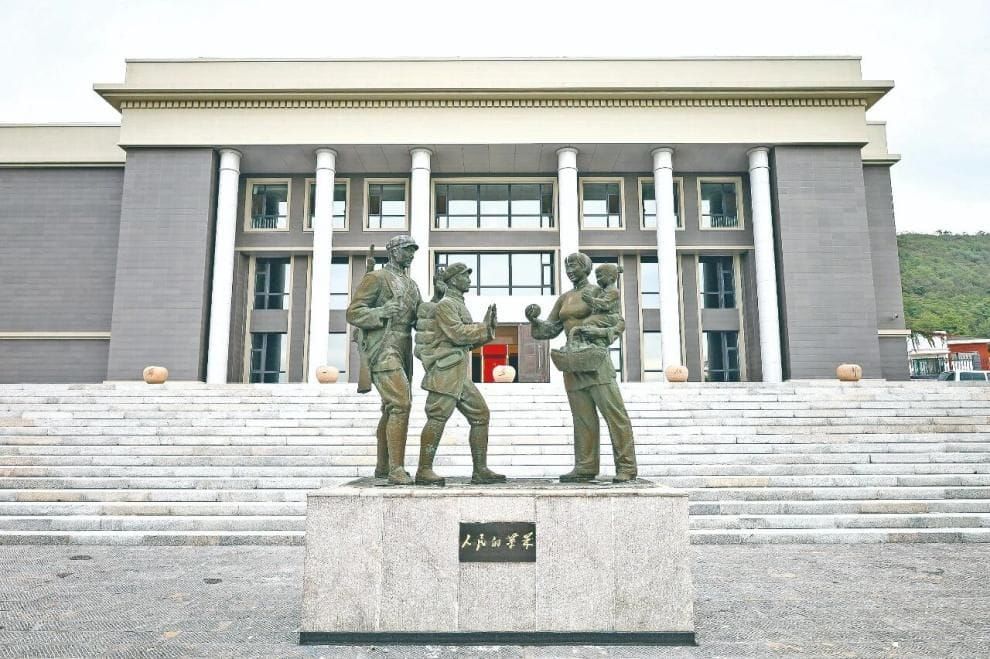
About a 20-minute drive from the Liaoshen Campaign Memorial is the Jinzhou Apple Integrity Education Base, where a sculpture entitled the "People's Apples" stands out. Inside the special-themed exhibition hall, docent Sun Yimeng was giving a vivid account, guiding visitors through historical photos and precious cultural relics.
"We take the 'People's Apples' as our underlying theme to convey to every visitor the Communist Party of China's fine conduct, strict discipline and original aspiration to serve the people," said Sun.
"Declining the apples reflects discipline; avoiding even the smallest exploitation of citizens demonstrates dedication to public service. We must carry forward the revolutionary heritage, uphold our revolutionary legacy, foster and put into practice a correct approach to evaluating political performance, exercise power with integrity, and effectively protect and advance the interests of the people," said Guan Hua, an official with the Jinzhou municipal people's congress, during a study visit.
Jinzhou has translated this historical lesson into actionable governance. On one front, the city enforces a zero-tolerance stance toward corruption in sectors directly impacting livelihoods, including rural collective assets, healthcare, and education. Targeted campaigns have been launched to root out misconduct that harms ordinary citizens. On another, Jinzhou focuses on "growing apples for the people" by improving the business climate. The local government has institutionalized dialogue with enterprises, established direct policy-delivery channels, and implemented 32 regulatory frameworks to streamline operations and support sustainable growth.
Clean governance, officials stress, is not merely about restraint -- it is a foundation for effective public service. To embed accountability into daily operations, inspectors from Jinzhou's Municipal Commission for Discipline Inspection now work alongside staff at the city's 12345 public service hotline and government service centers. A QR code-based oversight system has been rolled out across all 283 service windows, enabling real-time feedback and monitoring. The results are tangible: government services in Jinzhou have become increasingly standardized and efficient. Over 900 administrative procedures can now be completed on the same day, with many finalized in under two hours.
From a wartime promise of restraint to a modern blueprint for transparent administration, the "People's Apples" story continues to remind officials that true authority flows from serving the people with integrity.
"The tests of the times keep evolving, yet our original aspiration to serve the people remains unchanging," said Zhao Yu, an official with the Jinzhou municipal commission for discipline inspection. "We unswervingly uphold rigorous discipline, nurture a sound and upright political climate to edify the public and bolster high-quality development. We must never take the people's apples."