Chizhou's Bamboo Revolution: A Sustainable Model for Green Industry
Chizhou in east China is pioneering a sustainable bamboo industry, replacing plastics and reducing carbon emissions. Innovative pyrolysis technology and solar power drive this eco-friendly transformation.
Par Li Junjie, People's Daily
Inside a bamboo factory in Chizhou, east China's Anhui province, an intelligent production line operates at full capacity, producing bamboo straws.
The statistics are impressive. Annually, the city manufactures 2 billion bamboo straws, distributed across China and over 40 countries worldwide. This output replaces approximately 6,000 tons of plastic products while reducing carbon emissions by 36,000 tons.
Bamboo's rapid growth and carbon sequestration capabilities make it an ideal green alternative to single-use plastics. However, traditional processing methods historically utilized only 30% of the moso bamboo plant, leaving 70% as waste (shavings, powder, and offcuts) that was typically burned, discarded, or sold unprocessed.
In 2024, Anhui Hongye Group Co., Ltd. (Hongye Group), a leading bamboo enterprise in Chizhou, introduced the country's first complete set of full-bamboo resource pyrolysis equipment—a technology-driven move to turn bamboo waste into treasure and make full use of the plant.
The bamboo straw's green credentials extend well beyond the finished product. The manufacturing process itself has gone low-carbon from end to end.
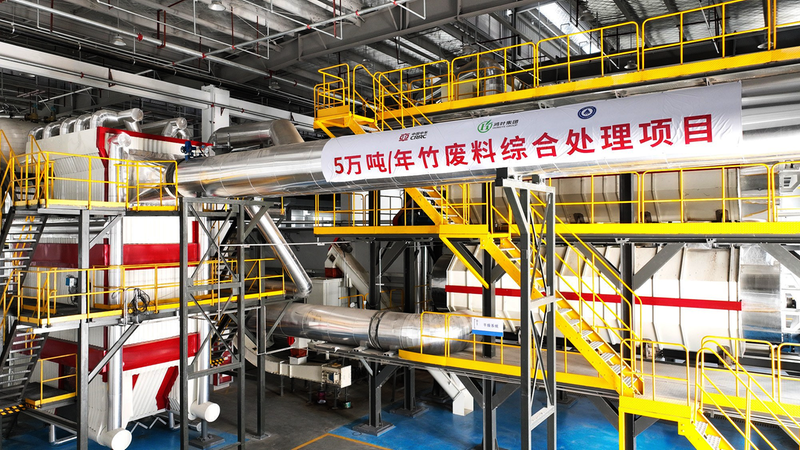
Inside Hongye Group's pyrolysis workshop, an intelligent monitoring screen displays everything in real time: bamboo waste is automatically conveyed through sealed pipelines into a pyrolysis furnace, where it undergoes conversion in a high-temperature, oxygen-free environment.
After pyrolysis, bamboo shavings, powder, and offcuts are transformed into combustible gas and biomass charcoal powder, said Wu Gang, head of the company's safety and environmental protection department, gesturing at the real-time data flickering on a display. The combustible gas is burned to generate steam heat, which is then piped to drying chambers to dry bamboo—fully replacing the conventional use of natural gas. The biomass charcoal powder, with a purity exceeding 98%, can be further processed into premium activated carbon or used as a negative electrode material for sodium-ion batteries, extending the bamboo industrial chain with high added value.
The technological upgrade has delivered tangible ecological and economic benefits. "Waste used to be a burden on production has transformed into a renewable resource," said Yang Dezhen, deputy general manager of Hongye Group. The company can now process 50,000 tonnes of bamboo waste annually in an environmentally sound manner, replacing approximately 4.8 million cubic meters of natural gas and directly cutting carbon dioxide emissions by 7,500 tonnes. The equipment has increased the company's overall bamboo utilization rate from 30% to more than 95%, bringing open-air burning and indiscriminate disposal to a complete halt.
Chizhou has established a circular chain running from bamboo waste to clean energy and advanced new materials.
Outside the pyrolysis workshop, deep-blue photovoltaic panels stretch across the factory rooftops, converting sunlight into clean electricity for each production workshop across the factory.
"Photovoltaic power generation serves as a key 'green engine' for the factory," said Zhang Jinfeng, office director of Hongye Group. Leveraging its 240-mu (16 hectares) industrial park, the company has built a distributed solar power station spanning more than 46,000 square meters. The station generates 5 million kilowatt-hours of electricity annually, meeting nearly one-third of the facility's power needs and cutting carbon dioxide emissions by 5,000 tonnes each year.
"The clean electricity now flows through every stage of production, from bamboo processing and precision finishing to final packaging, powering every step as we steadily move toward energy self-sufficiency on site," Zhang said.
At 5:00 a.m., villager Shu Rengui in Languan village, Hengdu town, Shitai county, Chizhou, is already deep in the hills harvesting moso bamboo.
In the past, Shu had to hire a vehicle just to haul his bamboo to the county seat—a costly undertaking. Today, he needs only to deliver it to the village-level processing plant barely a kilometer away. Short-haul transport and local processing have not only put green earnings within easy reach of rural households but also reduced the carbon footprint during the transportation process to some extent.
Chizhou now has more than 20 such moso bamboo processing plants, which together with circular industrial parks for the bamboo industry form a production system featuring tiered processing, efficient utilization, and closed-loop emission reduction.
At the upstream end, village-level processing enables low-carbon collection and distribution, trimming emissions from transportation; in the middle stage, pyrolysis technology converts waste into resources; at the downstream end, photovoltaic power supply and intelligent management systems work in tandem to continuously reduce industrial energy consumption.
Chizhou's low-carbon circular production model has also been replicated across other bamboo-rich regions of China, with 21 distributed circular industrial parks signing agreements to adopt it so far.
Chizhou is applying a low-carbon approach across the entire bamboo industrial chain to forge a pathway that links natural resources, ecological benefits, industrial development, and people's livelihood.